
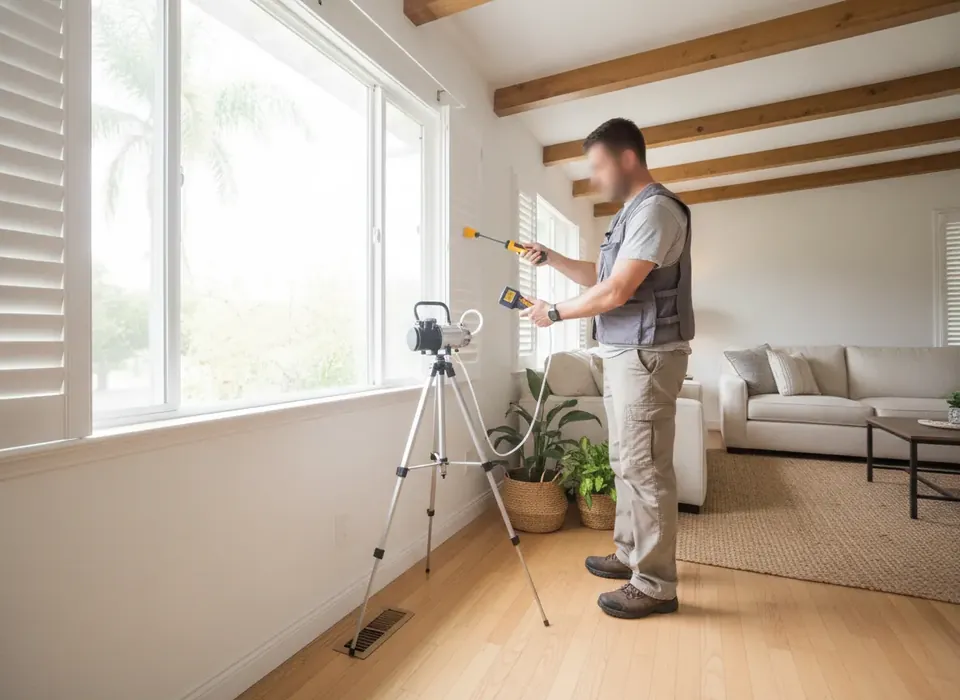
"Should I get it tested?" is one of the first questions people ask after spotting mold or smelling something musty. The honest answer is: sometimes. Testing can be useful, but it is not always the step that solves the problem, and California law does not require it for homeowners.
This guide separates inspection from testing, explains when each is worth it, and points out what lab numbers can and cannot tell you. If you already know you want an inspection, see mold inspection and testing in Santa Rosa, CA.
Short answer. If you can see mold and you know where the water came from, the next step is usually fixing the moisture and planning removal, not lab work. Testing helps most when the mold is hidden, the source is unclear, or you need a record that the cleanup worked.
Inspection and testing are not the same thing
A mold inspection is a visual and moisture investigation. An inspector looks for growth and water staining, uses a moisture meter on walls, floors and framing, may use a thermal camera to find cold, damp spots, and checks the likely sources: roof, plumbing, windows, crawl space and ventilation.
Mold testing means collecting samples for a lab. Common types:
- Air samples. A pump draws air through a cassette, inside and usually outside for comparison. The lab counts spore types.
- Surface samples. Tape lifts or swabs from a stain, to identify whether it is mold and what kind.
- Bulk samples. A small piece of material sent to the lab.
Many inspections include a few samples. Many problems are diagnosed without any.
What California actually says about testing
California's Toxic Mold Protection Act of 2001 asked the state health department, now CDPH, to develop exposure limits and assessment standards for indoor mold. The Act itself says the department must ensure that air or surface testing is not required to decide whether mold is a health threat. CDPH later reported that science-based exposure limits for indoor mold could not be set, and it never adopted them.
In practice, that means:
- There is no California "safe" spore count to test against.
- California does not require homeowners to test for mold.
- California does not issue a mold inspector license, so ask about training, experience, the lab used and a sample report.
- For rentals, the 2016 substandard-housing rule focuses on visible mold growth as determined by a health or code enforcement officer, not on lab counts.
The full legal picture is in California mold laws: what they require.
When mold testing is worth it
| Situation | Is testing useful? | Why |
|---|---|---|
| Musty smell, no visible mold | Often yes | Helps confirm a hidden problem and narrow where to look |
| Visible mold, known leak | Usually not needed first | EPA guidance says sampling is usually unnecessary when growth is visible; fix the water and plan removal |
| After remediation | Often yes | Clearance testing documents that the area was cleaned before walls are closed up |
| Buying or selling a home | Sometimes | A report can support negotiations or disclosures; inspection findings matter more than spore counts |
| Rental dispute | Sometimes | Photos and written notice matter most; an inspection report can add detail |
| Doctor asked about mold exposure | Discuss with your doctor | Testing a home does not diagnose anyone; follow medical advice |
What a lab result cannot tell you
Air samples are snapshots. Spore counts swing with weather, time of day, and whether someone just walked through the room. A single "normal" result does not prove a wall cavity is clean, and a high result does not show where the source is. Results also cannot tell you whether a material needs to be removed. That decision depends on what is wet, what is growing, and what it is growing on.
That is why a useful report connects samples to moisture readings and a written explanation of where the water came from. If a report is just a lab sheet with no findings, ask for more.
Why a Santa Rosa home may smell musty without visible mold
Santa Rosa gets about 83% of its yearly rain between November and March, and almost none from June through September (NOAA 1991–2020). A leak from a winter storm can dry at the surface by summer while mold keeps growing inside a wall or under a floor. Many people notice a musty smell the first time the heat runs in October or November, especially in homes with a crawl space or ducts under the floor. In that situation an inspection, sometimes with air samples, can help narrow the search. Our crawl space mold guide explains that pattern.
Independent inspector or the remediation company?
California does not require separate companies for testing and removal. Still, on larger jobs many homeowners prefer an inspector who does not do the removal work, so the scope is written by someone without a stake in its size. The same independent inspector can then do the clearance check at the end. On small, obvious jobs, an inspection by the remediation company may be enough. Ask each company which approach it recommends and why.
What mold testing costs
homeyou lists $284–$446 for a Santa Rosa mold inspection on a 500 square foot example (Sep 2026). Fixr puts a separate inspection at $450–$800 nationally (2025). Post-remediation clearance testing is often a separate invoice, and the number of lab samples drives much of the difference. The Santa Rosa cost page has the full table and a calculator. These are published estimates, not quotes.
Questions to ask before you book
- What does the inspection include: moisture mapping, thermal imaging, how many samples?
- Which lab analyzes the samples, and is it accredited?
- Will I get a written report with photos, moisture readings and recommendations?
- Do you also do removal? If so, how do you keep the two roles separate?
- Can you do the clearance check after the work is done?
If you are worried about health effects, see a doctor. EPA and CDC advise fixing moisture and removing mold rather than relying on test numbers to decide whether a home is safe.
Frequently asked questions
Is mold testing required in California?
No. California does not require homeowners to test for mold, and the Toxic Mold Protection Act says testing is not required to decide whether mold is a health threat. CDPH never adopted mold exposure limits, so there is no state number to test against. Testing is a tool you can choose when it answers a real question.
Do I need a mold test if I can see the mold?
Usually not as a first step. EPA guidance says sampling is generally unnecessary when growth is visible. The more useful steps are finding and fixing the water source and getting the moldy material removed or cleaned properly. Testing can still help afterward, as a clearance check before walls are closed.
How much does mold testing cost in Santa Rosa, CA?
homeyou lists $284–$446 for a Santa Rosa mold inspection on a 500 square foot example (September 2026), while Fixr lists $450–$800 for a separate inspection nationally. The number of lab samples, home size and access drive the price. Quotes come from the independent companies, not from this site.
Are mold inspectors licensed in California?
California does not issue a mold inspector license. Ask inspectors about their training and experience, which accredited lab they use, and for a sample report. If an inspector also offers to do repair or removal work of $1,000 or more, that work requires a CSLB contractor license, which you can check online.
Want an inspection or a second opinion? Request free quotes from independent Santa Rosa, CA and Sonoma County companies, or call (707) 896-6015. Santa Rosa Mold Pros is a free quote service; the companies send their own prices.