
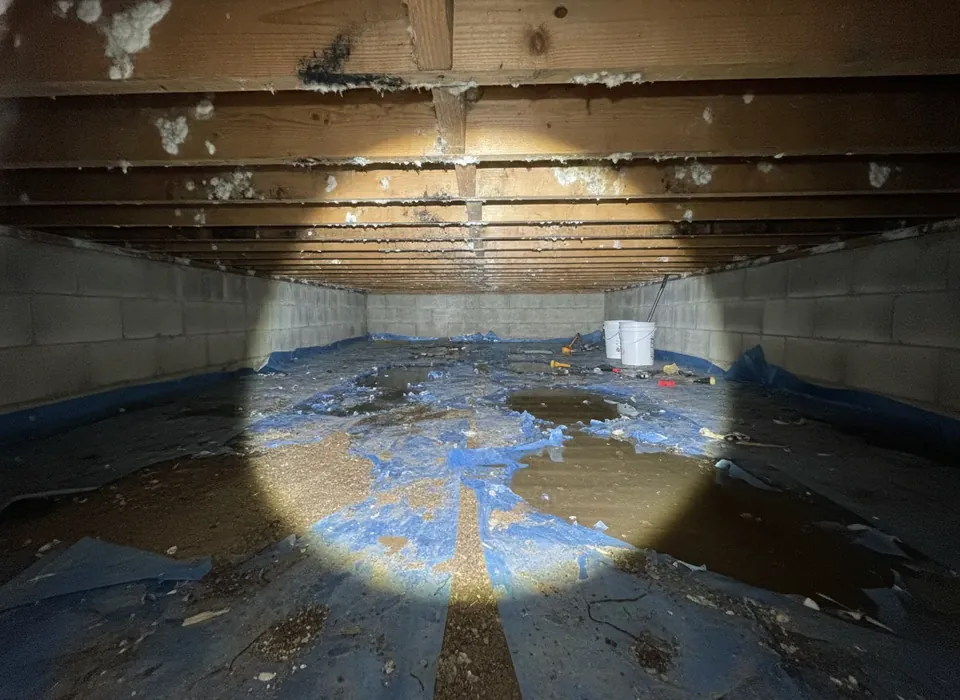
A musty smell that shows up when the heater kicks on in the fall. Hardwood boards that start to cup. Allergy-like stuffiness that seems worse indoors. In many Sonoma County homes, these trace back to the crawl space, the shallow space between the soil and the floor.
Crawl space mold is common here for local reasons, and it can be fixed. This guide explains why it happens, what to look for, and what a company should include in a quote. For the service page, see crawl space mold in Santa Rosa, CA.
Why crawl spaces in Sonoma County get moldy
Older homes on raised floors
Santa Rosa's median home was built in 1980, and half the city's homes predate it (ACS 2024). Sonoma County's numbers are similar. Many older homes here have raised wood floors over a crawl space, while most new homes are built on slabs. Under those floors sit wood joists, a wood subfloor and often fiberglass insulation, all of which can grow mold if they stay damp.
Winter rain, then a long dry summer
About 83% of Santa Rosa's rain falls from November through March, with December and February the wettest months (NOAA 1991–2020). Runoff and groundwater can pond under a house for weeks. Then the summer is nearly dry, so the problem fades from view until the next rainy season. Damp soil keeps adding moisture to the air under the floor the whole time.
Vents, fog and shade
Foundation vents are meant to dry the space, but in cool, damp weather they can bring in moist air that condenses on cold wood. West-county homes near the Russian River, in Sebastopol and under redwoods get fog and shade that keep the ground wet longer. Homes along the Laguna de Santa Rosa and other flood-prone areas can get water under the house during storms.
Ducts and plumbing under the floor
Furnaces and ducts often run through crawl spaces. A disconnected or leaking duct can push warm, moist air into the space, and condensation can form on ducts. Old supply and drain lines can drip for months before anyone sees it. Duct wrap, flooring and other materials in older homes may also contain asbestos, which matters before anyone tears them out.
Signs your crawl space may have mold
| What you notice | Possible cause under the floor |
|---|---|
| Musty smell when the heat first runs in fall | Damp joists or insulation, ducts pulling air from the crawl space |
| Cupping or soft hardwood floors | High moisture under the subfloor |
| Insulation sagging or fallen onto the soil | Wet batts that have taken on water weight |
| Standing water or wet soil after storms | Poor drainage, gutters or grading sending water under the house |
| White, gray or black growth on joists | Mold, or sometimes harmless mineral deposits; an inspection tells which |
| Higher humidity indoors in winter | Moist crawl space air moving up into the house |
What you can check safely
You can often learn a lot from the access hatch without crawling in. Use a bright flashlight and look for standing water, fallen insulation and stains or growth on the wood. Take photos. Do not crawl in if there is standing water near electrical lines, if you have breathing problems, or if you see damaged pipe or duct insulation in an older home, which could contain asbestos. A crawl space is a confined, dirty space, and a company with the right gear can inspect it for you.
Do not just spray it. Bleach or a store-bought spray on joists may change the color but does nothing about the water under the house. Without a moisture fix, crawl space mold tends to return with the next wet season.
What a proper crawl space fix includes
A good quote should cover both the mold and the moisture. Independent companies typically handle some or all of these steps:
Inspection and moisture readings
Measuring moisture in joists and subfloor, finding water entry points and checking ducts, plumbing and vents. See mold inspection and testing.
Water control
Fixing gutters and downspouts, grading, or drainage so water stops collecting. Some of this may be another trade.
Removal and cleaning
Removing wet or moldy insulation and debris, then HEPA vacuuming and cleaning or treating framing where mold has grown.
Drying
Dehumidifiers and air movement until the wood reaches normal moisture levels.
Keeping it dry
A ground vapor barrier, sealing duct leaks, and, depending on the home, ventilation changes, a dehumidifier or crawl space encapsulation.
Ask which steps are in each quote. A low price may cover only cleaning, while a higher one includes the vapor barrier and drainage.
What crawl space mold removal costs
Fixr's 2025 guide puts crawl space mold remediation at about $500–$2,000. Drainage work, new insulation, duct repair and full encapsulation are often priced separately and can add significantly. North Bay labor costs may run above national averages. The Santa Rosa cost page has the full table and a calculator, and our guide to reading a mold quote shows how to compare offers. These are published estimates, not quotes.
California rules that apply under the house
- California has no mold license, but any job of $1,000 or more, any job needing a permit, or any job using employees must be done by a CSLB-licensed contractor. Check the license online.
- Duct and furnace work generally falls under a C-20 class and may need a permit. Asbestos work of 100 square feet or more needs Cal/OSHA registration and a C-22 license.
- For pre-1978 homes, ask whether the company is EPA Lead-Safe Certified if painted surfaces will be disturbed.
- The down payment generally cannot exceed $1,000 or 10% of the price, whichever is less.
Mold from slow, long-term moisture under a house is usually excluded from homeowners insurance, according to the California Department of Insurance. Water from a sudden pipe burst may be treated differently. Call your insurer before work begins, and see does homeowners insurance cover mold in California.
When to act quickly
Call soon if there is standing water under the house, if floors feel soft, if the smell is strong in living areas, or if someone in the home has asthma or other breathing problems. For health symptoms, see a doctor. Late fall, before the heaviest December to February rain, is a practical time to get a crawl space looked at.
Frequently asked questions
Why does my house smell musty when the heat comes on?
In many Sonoma County homes the furnace and ducts sit in the crawl space. When the heat first runs in fall, leaky ducts can pull damp, musty air from under the floor into the house. Damp joists, wet insulation or standing water below are common causes. An inspection with moisture readings can find the source.
Is crawl space mold dangerous?
EPA and CDC say mold can cause stuffy noses, irritation and asthma flare-ups in sensitive people, and that any indoor mold growth should be fixed along with the moisture causing it. Crawl space air often moves up into living areas. If anyone in the home has symptoms, see a doctor, and have the crawl space checked.
How much does crawl space mold removal cost in Sonoma County?
Fixr's 2025 guide lists $500–$2,000 for crawl space mold remediation nationally. Drainage, new insulation, duct repair and encapsulation are usually extra. North Bay labor costs may be higher. Independent Sonoma County companies give actual quotes after seeing the space; the figures here are published estimates only.
Do I need a vapor barrier or encapsulation?
Many crawl spaces need at least a ground vapor barrier to slow moisture rising from the soil. Full encapsulation, sealing vents and walls and controlling humidity, suits some homes but not all. Ask companies to explain why they recommend one option over another, and to fix drainage problems first.
Smell something under the floor? Describe your crawl space and independent Santa Rosa, CA and Sonoma County companies can reply with quotes, or call (707) 896-6015. Santa Rosa Mold Pros is a free quote service; the companies inspect and quote directly.