
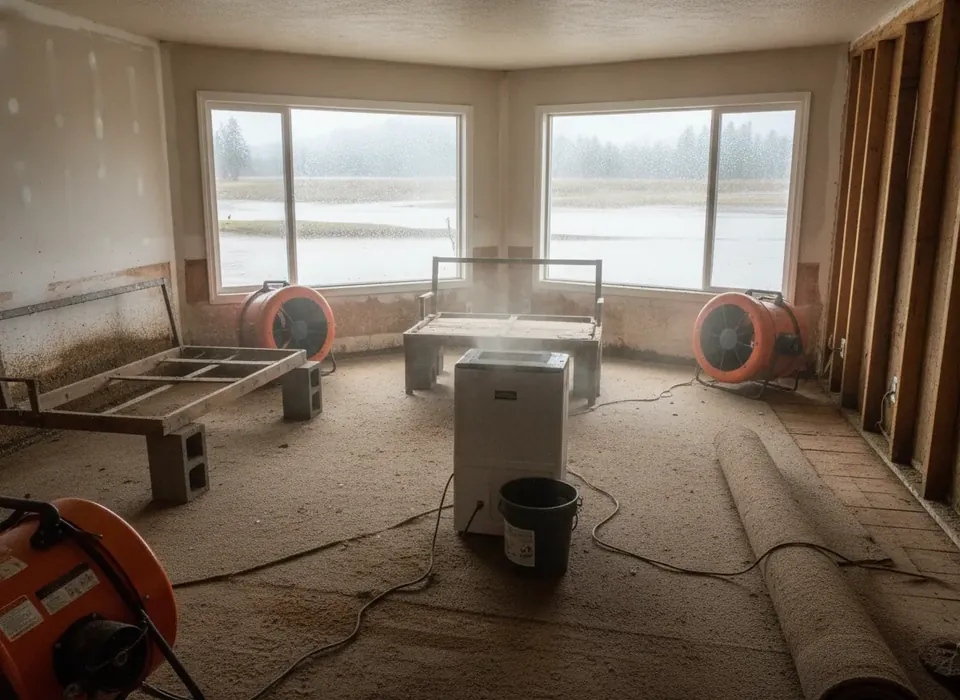
The Russian River floods often enough that many river residents have a routine. Mold is the part that catches people later. Flood water soaks drywall, insulation and the wood under the floor, and in the cool, foggy, shaded river canyon those materials can stay wet for a long time.
This guide covers what to do once it is safe to go back in. For the service itself, see mold after floods, storms and leaks and mold remediation in Guerneville and the Russian River.
How often the river floods here
At Guerneville, the Russian River's flood stage is 32 feet. On February 27, 2019, it crested at 45.38 feet, the highest since 1995 (NWS). The record is 49.5 feet in February 1986. That 2019 flood affected about 1,900 homes countywide, with early damage estimates around $155 million. Sonoma County has had federal disaster declarations for winter storms in 2017, 2019 and January 2023.
River housing adds risk. Guerneville's median home was built in 1955, the oldest in the area, and about a quarter of its homes are seasonal or vacation cabins (ACS). A cabin that sits closed up after a flood can grow mold for weeks before an owner sees it.
The first 48 hours
Safety first. Do not go back in until officials say it is safe. Keep the power off until an electrician or PG&E says it is safe, watch for gas smells and structural damage, and treat flood water as contaminated. Wear rubber boots, gloves, eye protection and an N95 respirator during cleanup. CDC advises people with asthma, other lung conditions or weakened immune systems to stay out of mold cleanup.
- Photograph everything before moving or throwing anything out: water lines on walls, floors, contents, the crawl space if visible.
- Call your insurers. Flood damage usually needs flood insurance, which is separate from a homeowners policy.
- Get water and mud out and open doors and windows when the weather allows.
- Start drying. EPA advises drying wet materials within 24 to 48 hours to prevent mold growth. Fans and dehumidifiers help once power is safe.
- Pull wet carpet and pads and move soaked furniture out.
What usually has to come out
Flood water carries silt, sewage and debris, so the usual rule is stricter than for a clean-water pipe leak.
| Material | Usual approach after a river flood |
|---|---|
| Carpet and pad | Usually discarded |
| Drywall below the water line | Usually cut out, often a foot or more above the line, to reach wet insulation |
| Fiberglass wall and floor insulation | Usually removed once soaked |
| Wood framing and subfloor | Cleaned and dried; replaced if damaged or decayed |
| Hard flooring, tile, metal | Cleaned and disinfected |
| Upholstered furniture, mattresses | Usually discarded if soaked |
Do not close walls back up until the framing tests dry with a moisture meter. Closing wet walls is one of the most common causes of mold that shows up months later.
In a pre-1981 home, which describes most river homes, ask about an asbestos survey before cutting out drywall, joint compound or flooring. Asbestos work of 100 square feet or more needs Cal/OSHA registration and a C-22 licensed contractor. For pre-1978 homes, ask whether the company is EPA Lead-Safe Certified.
Under the house
Many river homes are raised, and much of Guerneville's housing has been elevated over the years. That keeps living spaces drier but leaves the underside of the floor, joists and insulation exposed to flood water and lingering damp. After the water recedes, have the crawl space or under-house area checked for wet insulation, silt and standing water. Our crawl space mold guide explains what a proper fix includes.
Watch for storm chasers
After a flood, contractors from outside the area sometimes go door to door. California law offers specific protections here. Generally:
- Unlicensed contracting for repairs in a declared disaster area is a crime (B&P 7028.16). Check any contractor's CSLB license online before signing.
- Contracts to repair damage from a declared disaster generally carry a 7-day right to cancel (B&P 7159).
- The down payment generally cannot exceed $1,000 or 10% of the contract price, whichever is less.
- Get the scope and price in writing, and do not pay in full up front.
California does not issue a mold-specific license, but any job of $1,000 or more, any job needing a permit, or any job with employees requires a CSLB-licensed contractor. See hiring a CSLB-licensed contractor for mold.
Permits for river towns
Guerneville, Monte Rio and Forestville are unincorporated, so Permit Sonoma handles permits. Its exemption list covers minor drywall repair only up to 100 square feet, so a larger flood rebuild generally needs a permit, as do electrical, plumbing and structural repairs. Ask the company or Permit Sonoma before rebuilding.
Insurance after a flood
The California Department of Insurance says flood coverage is generally not provided in homeowners or renters policies; it comes from separate flood insurance. Mold is usually excluded from homeowners policies too. If you have flood insurance, ask your insurer how it handles mold that follows a flood, and report the loss quickly. Keep every receipt and photo. See does homeowners insurance cover mold in California for the broader picture.
Second homes and cabins
If you own a cabin you do not live in, ask a neighbor or property manager to check it as soon as access reopens, take photos and start drying. Every week a flooded cabin sits closed up adds to the mold. When you get quotes, ask whether the company can coordinate access and send photo updates.
What it may cost
Published guides put mold remediation at roughly $10–$25 per square foot of affected area, and whole-house jobs at $10,000–$30,000 (This Old House 2026; Fixr 2025). Flood jobs often add water extraction, drying equipment and rebuild. The Santa Rosa cost page has the full table and calculator. These are published estimates, not quotes.
Frequently asked questions
How soon does mold grow after a flood?
EPA advises drying wet materials within 24 to 48 hours to prevent mold growth. After a Russian River flood, cool and shaded conditions can keep homes wet much longer, so growth often starts before everything dries. Remove soaked porous materials, run fans and dehumidifiers once power is safe, and check framing with a moisture meter before closing walls.
Does homeowners insurance cover mold after a Russian River flood?
Usually not by itself. The California Department of Insurance says flood is generally not covered by homeowners or renters policies and needs separate flood insurance. Mold is usually excluded as well. If you carry flood insurance, ask how it treats mold that follows a flood, report quickly, and keep photos and receipts.
Do I need to tear out drywall after a flood?
Usually, drywall and insulation soaked by river water are cut out above the water line, because flood water carries silt and sewage and wet insulation inside walls holds moisture. In older river homes, ask about an asbestos survey before cutting. In unincorporated areas, Permit Sonoma exempts drywall repair only up to 100 square feet.
How can I avoid a bad contractor after a flood?
Check the CSLB license online before signing, get a written contract, and keep the down payment to $1,000 or 10%, whichever is less. Contracts to repair damage from a declared disaster generally carry a 7-day right to cancel, and unlicensed disaster-repair work is a crime in California. Be wary of door-to-door offers.
Dealing with flood damage on the river? Request free quotes from independent Sonoma County companies that work in Guerneville, Monte Rio and Forestville, or call (707) 896-6015. Santa Rosa Mold Pros is a free quote service; the companies quote and do the work directly.